Why Choose a PTFE Stir Rod for Chemical Mixing?
Why Choose a PTFE Stir Rod for Chemical Mixing?
A Ptfe Stir Rod offers a dependable option for laboratories handling aggressive chemicals, reactive solutions, and temperature-sensitive mixtures. Its surface resists many acids, bases, solvents, and oxidizing agents. It also produces minimal friction inside glass beakers and laboratory vessels. That matters when gentle mixing protects delicate samples.
Roy J. Plunkett, the DuPont chemist credited with discovering PTFE, described its origin as “a serendipitous discovery.” His work helped establish PTFE as a significant high-performance material. Today, laboratory professionals still value its low surface energy and broad chemical resistance. A Ptfe Stir Rod does not easily absorb liquids, retain residues, or introduce unwanted particles during routine mixing. Cleaning can be simple. Inspection remains essential.
The choice is not perfect.
PTFE can deform under excessive force or prolonged high temperatures. It may also become scratched when used against rough containers or sharp equipment. Experienced technicians therefore match rod size, stirring pressure, and operating temperature to the application. They inspect the surface before each use. Small cracks can compromise cleanliness and performance.
A Ptfe Stir Rod is most useful when chemical compatibility, smooth handling, and easy cleaning matter. It supports controlled laboratory work, but it cannot replace proper testing. Always confirm compatibility with the exact chemicals, temperature range, and mixing conditions. That careful step is easy to overlook. It should not be.
PTFE Stir Rod Fundamentals: Composition, Density (~2.15 g/cm³), and Structure
Why Choose a PTFE Stir Rod for Chemical Mixing?
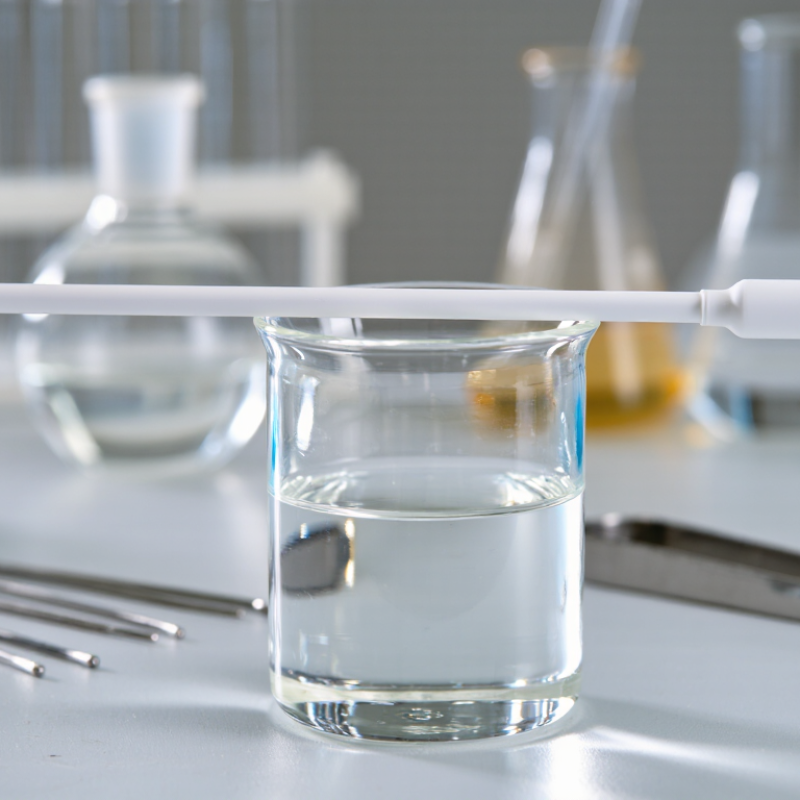
PTFE stir rods are made from polytetrafluoroethylene, a fluorine-rich polymer with strong carbon-fluorine bonds. This structure gives PTFE excellent resistance to many acids, bases, solvents, and moisture. Its smooth, nonporous surface also limits liquid absorption and reduces residue after mixing. That matters when a small amount of contamination can affect the next test.
The density of solid PTFE is approximately 2.15 g/cm³. It usually sinks in water and many common laboratory liquids. However, density is not a guarantee of stability in every solution. Highly concentrated liquids may change how the rod moves or settles. I check the liquid’s density when consistent mixing matters. This simple step is easy to overlook.
PTFE also has a low-friction surface, so the rod moves smoothly against glass and compatible containers. It resists sticking, but it is not indestructible. Sharp edges, excessive force, and high temperatures can damage its surface or shape. A slightly bent rod may still work, yet it can create uneven movement and poor mixing. I prefer a straight rod with clean, rounded ends. Visual inspection remains useful, even when the material appears chemically reliable.
Chemical Compatibility: PTFE Resistance Across Acids, Bases, and Solvents
Why Choose a PTFE Stir Rod for Chemical Mixing?
Chemical compatibility is PTFE’s strongest practical advantage. Published technical data commonly place its density near 2.14–2.20 g/cm³, according to ASTM D792 testing. More importantly, PTFE remains stable against many concentrated acids, diluted bases, and common laboratory solvents. It shows low water absorption, often reported below 0.01%, which helps prevent swelling during repeated wet-dry cycles. That matters when a stir rod moves through a clear acid bath or a strongly alkaline solution.
The resistance is not universal. Molten alkali metals, elemental fluorine, and some highly reactive fluorinating agents can attack PTFE. Elevated temperature also changes the risk profile. Technical guidance commonly lists continuous service near 260°C, but actual performance depends on load, exposure time, and mechanical stress. ASTM D543 immersion testing is useful because it examines visible changes, mass variation, and strength retention after chemical contact. A rod that looks unchanged may still become less reliable under bending.
In practice, I inspect the rod after each demanding run. Fine scratches can trap residues, especially in viscous solvents. That small detail is easy to miss. Compatibility charts are valuable, but they are not laboratory-specific guarantees. Concentration, temperature, impurities, and mixing speed can alter results. PTFE is an excellent default for many chemical mixtures, yet careful users should verify unusual combinations with immersion data and a controlled trial. That extra step may feel excessive. Sometimes it prevents a failed experiment.
Why Choose a PTFE Stir Rod for Chemical Mixing?
Chemical Compatibility: PTFE Resistance Across Acids, Bases, and Solvents
| Chemical Category |
Typical Chemical |
Example Concentration |
Typical Condition |
PTFE Compatibility |
Practical Note |
| Mineral acids |
Hydrochloric acid |
Up to concentrated aqueous solutions |
20–25°C |
Excellent |
Very low chemical reactivity; inspect the rod if exposed to elevated temperatures. |
| Mineral acids |
Sulfuric acid |
10–98% aqueous solutions |
20–25°C |
Excellent |
Suitable for routine mixing; hot concentrated acid requires a process-specific review. |
| Oxidizing acids |
Nitric acid |
Up to concentrated acid |
20–25°C |
Excellent |
PTFE is generally resistant, but the chemical handling hazard remains severe. |
| Strong acids |
Hydrofluoric acid |
Dilute to concentrated aqueous solutions |
20–25°C |
Excellent |
PTFE is chemically resistant; HF still requires dedicated controls and compatible surrounding equipment. |
| Organic acids |
Acetic acid |
Glacial to dilute solutions |
20–100°C |
Excellent |
Suitable for laboratory mixing over a broad concentration range. |
| Strong bases |
Sodium hydroxide |
Up to concentrated aqueous solutions |
20–100°C |
Excellent |
Resistant to aqueous alkalis; avoid contact with molten alkali metals. |
| Strong bases |
Potassium hydroxide |
Up to concentrated aqueous solutions |
20–100°C |
Excellent |
Appropriate for aqueous alkaline mixing within the rod’s temperature limits. |
| Polar solvents |
Acetone |
Pure solvent or mixtures |
20–25°C |
Excellent |
PTFE does not normally dissolve or chemically react with acetone under ambient conditions. |
| Alcohols |
Ethanol |
Pure solvent or aqueous mixtures |
20–78°C |
Excellent |
Well suited to routine stirring and cleaning applications. |
| Aromatic solvents |
Toluene |
Pure solvent or mixtures |
20–25°C |
Excellent |
Chemical attack is unlikely; prolonged exposure may require attention to permeation and contamination control. |
| Halogenated solvents |
Dichloromethane |
Pure solvent or mixtures |
20–25°C |
Excellent |
PTFE offers strong resistance; evaluate vapor exposure and mechanical strength at elevated temperatures. |
| Polar aprotic solvents |
Dimethyl sulfoxide |
Pure solvent or mixtures |
20–100°C |
Excellent |
Suitable for many laboratory formulations and high-purity mixing tasks. |
| Specialty chemicals |
Elemental fluorine and chlorine trifluoride |
Reactive gases or liquids |
Any condition |
Not recommended |
Highly reactive fluorinating agents can attack PTFE and require specialized materials review. |
| Molten alkali metals |
Sodium or potassium metal |
Molten state |
Above melting temperature |
Not recommended |
Do not generalize PTFE’s resistance to aqueous bases to molten alkali metals or extreme reducing conditions. |
Compatibility guide:
“Excellent” indicates that PTFE is generally resistant under the stated conditions. Actual performance depends on temperature, exposure time, purity, mechanical loading, and the complete chemical formulation. PTFE’s continuous-use temperature is commonly limited to approximately 260°C, and the rod should be inspected before reuse in high-risk applications.
Thermal Performance: Continuous Use from −200°C to 260°C
Why Choose a PTFE Stir Rod for Chemical Mixing?
PTFE stir rods remain practical when laboratory temperatures change sharply. They support continuous use from approximately −200°C to 260°C. This range covers cryogenic handling, heated baths, and many controlled reaction vessels. ASTM D3418 testing places PTFE’s melting transition near 327°C. The margin matters. It separates normal operation from the material’s melting region.
At −200°C, PTFE usually retains chemical resistance, but it may become less forgiving under impact. A rod dropped onto a metal bench can chip or crack. At 260°C, the main concern is not melting. Creep, surface wear, and contamination risks deserve attention during long mixing cycles. Technical guidance aligned with ISO 11357 thermal analysis also shows why actual performance depends on heating rate, pressure, and sample history.
Check the vessel temperature directly.
In practical use, a PTFE rod should move smoothly without scraping glass walls. Its low surface energy helps reduce residue adhesion after viscous mixing. However, “continuous use” should not be treated as a universal promise. Load, agitation speed, and exposure time can change results. ASTM D4894 and ISO 12086 provide recognized frameworks for evaluating PTFE materials and grades. Reviewing the supplier’s test method remains essential, especially near 260°C. A conservative operator may reduce speed and inspect the rod after repeated heating cycles. That small discipline prevents an assumption from becoming a laboratory failure.
Low-Friction Mixing: How PTFE Reduces Drag and Particle Contamination
Why Choose a PTFE Stir Rod for Chemical Mixing?
Low friction is the main advantage of a PTFE stir rod during chemical mixing. Published tribology data summarized in the ASM Handbook, Volume 18, commonly place PTFE’s sliding friction coefficient near 0.04–0.10 against smooth surfaces. Lower friction means less drag as the rod moves through viscous liquids. It also reduces sudden resistance, splashing, and stress on manual mixing equipment. In practical laboratory work, the rod glides across glass with a noticeably smoother feel. That small difference can improve control during slow, delicate mixing.
Less rubbing may also reduce particle generation from contact surfaces. This matters when samples must remain visually clean or analytically consistent. However, PTFE is not contamination-proof. Excessive pressure, sharp vessel edges, or damaged surfaces can create wear debris. ASTM D1894 highlights how friction testing changes with load, speed, and surface condition. The result is not universal. A clean rod can still fail in a poorly controlled process. This is the part worth questioning.
Tips:
Inspect the rod before use. Reject scratched or cloudy surfaces. Use gentle, steady strokes instead of forcing the rod through thick material. Rinse according to the chemical’s compatibility requirements, then check for residue under bright light. Record unusual drag or visible particles; small observations often reveal process problems earlier than test results.
Selection and Safe Use: Diameter, Length, Cleaning, and ASTM Practices
A PTFE stir rod suits chemical mixing when low surface reactivity and easy release matter. Selection begins with diameter, not appearance. A thin rod works well for small vials and low-viscosity liquids. A thicker rod offers better control in dense solutions. Choose a length that reaches near the vessel bottom while leaving several centimeters for safe handling. Do not select length by vessel volume alone. A deep container can make a short rod awkward and unsafe.
Cleaning affects reliability. Rinse the rod immediately after use, before residues dry into a hard film. Use a compatible solvent, mild detergent, and a soft, non-abrasive cloth. Avoid blades, wire brushes, and rough scouring pads. They can create scratches that trap residues. Inspect the surface under bright light. A clean-looking rod may still carry traces. I would re-clean it when the liquid has strong color, odor, or unusual viscosity.
ASTM practices can support consistent selection and records, but the relevant method depends on the chemical, temperature, and test purpose. Check the current ASTM document before writing a procedure. Record rod diameter, length, cleaning agent, rinse steps, drying conditions, and inspection results. Confirm temperature limits and chemical compatibility from reliable technical data. PTFE is resistant, not invulnerable. Excessive force can bend it, and damaged surfaces deserve replacement. My own selection checklist would still include one uncomfortable question: could this rod introduce contamination into the next mixture?
PTFE stir rods are selected primarily by vessel size, mixing load, and clearance rather than by a single universal standard. Common laboratory dimensions range from about 3–10 mm in diameter and 150–300 mm in length. PTFE remains chemically resistant across a broad range of laboratory reagents, but its continuous-use temperature is commonly limited to approximately 260°C. Clean with compatible solvents or mild detergent, rinse thoroughly, and inspect for cracks, swelling, or contamination before reuse. ASTM D792 is commonly used for polymer density measurement, while ASTM D570 covers water absorption testing; these standards support material characterization rather than defining a universal stir-rod size.