Leave Your Message

How to Choose Ptfe Coated Magnetic Stir Bars in 2026?

Choosing the right Ptfe Coated Magnetic stir bar in 2026 requires more than comparing prices or package quantities. In real laboratory work, a stir bar can affect mixing consistency, sample recovery, and cleaning time. A bar that looks suitable in a catalog may slip at high speed, collect residue around its pivot ring, or fail inside a narrow vessel. This guide examines practical selection factors, including PTFE quality, core magnet strength, shape, dimensions, chemical compatibility, and operating temperature. It also considers manufacturer documentation, batch consistency, and evidence from laboratory use.

Small details matter.

Experienced technicians often match the bar length to the vessel diameter, then test vortex stability with water before using valuable samples. For aggressive solvents, strong acids, or heated solutions, users should verify compatibility through reliable technical data rather than assumptions. PTFE offers broad chemical resistance, but it is not a universal solution. Excessive heat, sharp vessel surfaces, and unsuitable stirring speeds can still reduce service life. The magnetic coupling also deserves attention. A powerful bar may not perform well if the stirrer plate has a weak drive magnet or poor alignment. I have seen simple oval bars work better than expensive designs in low-viscosity liquids, while larger samples required a cross-shaped bar for steadier movement. That experience is useful, but not conclusive. Product testing remains necessary. The following sections provide a careful framework for choosing a dependable Ptfe Coated Magnetic stir bar for modern laboratory applications.
How to Choose Ptfe Coated Magnetic Stir Bars in 2026?

Understanding PTFE-Coated Magnetic Stir Bars

How to Choose PTFE Coated Magnetic Stir Bars in 2026?

Understanding PTFE-coated magnetic stir bars begins with material behavior. PTFE offers low friction and strong resistance to many acids, bases, and solvents. The NIST Chemistry WebBook reports a PTFE melting point near 327°C. That number is not a safe working temperature. Magnetic performance may decline much earlier, especially with strong heating or poor vessel contact. ASTM D4894 and ASTM D4895 provide recognized specifications for PTFE resin quality and processing.

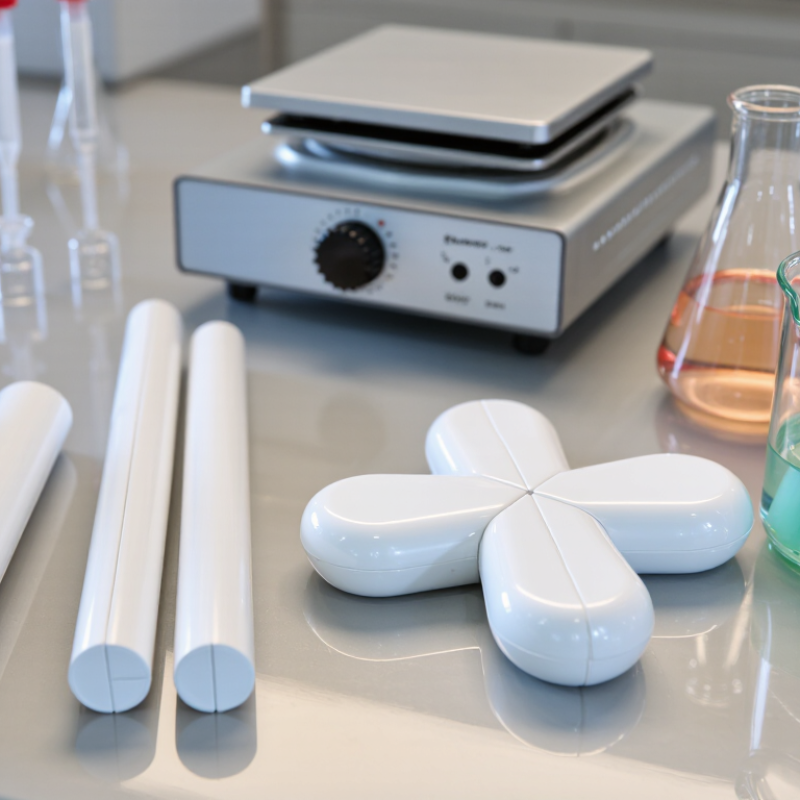
Size and shape matter during daily laboratory work. A 20–30 mm bar usually suits small beakers and sample vials. Longer bars can create stronger circulation in wider vessels, but they may wobble at high speed. Octagonal and cross-shaped designs often improve liquid movement. A smooth ring shape is easier to clean. Check the vessel diameter, liquid volume, and stir-plate strength before choosing. Small details matter.

Do not judge quality by coating appearance alone. Under a microscope, tiny scratches can expose the internal magnetic core. I have seen apparently clean bars produce unstable rotation after repeated washing. That mistake is easy to miss. Select bars with even PTFE coverage, rounded ends, and clear dimensional data. Replace any bar showing cracks, swelling, or permanent discoloration. The choice should match the solvent, temperature, speed, and cleaning routine, not only the advertised size.


Defining Your Stirring Application and Laboratory Requirements

Choosing PTFE-Coated Magnetic Stir Bars in 2026 begins with defining the work, not browsing shapes. Describe liquid volume, viscosity, temperature, vessel geometry, and mixing duration. A 50 mL aqueous sample needs a different bar from a 5 L viscous solution. Measure the vessel’s base. Note its curvature and clearance.

PTFE offers broad chemical resistance and a smooth surface that supports cleaning. It is not invulnerable. Strongly reactive conditions, abrasive solids, or excessive heat can damage the coating over time. Confirm compatibility with the actual solvent, temperature, and exposure period. Record these details in the laboratory method. That record improves repeatability and supports defensible purchasing decisions.

Match bar length to vessel diameter without crowding the walls. Octagonal bars often increase movement in low-viscosity liquids, while smooth cylindrical forms may suit gentle mixing. For powders or dense samples, coupling strength matters more than appearance. Test at the intended speed, not only in water. I have seen a bar spin neatly in a beaker, then stall inside a narrow flask. It happens. Leave enough clearance for a stable vortex, but avoid splashing and air entrainment. Inspect the coating after use, especially near edges and pivot rings. A small defect may be easy to overlook, yet it can affect cleaning confidence. If results remain inconsistent, question the bar selection and the setup itself.

Selecting the Right Shape, Size, and Magnetic Core

Choosing a PTFE coated magnetic stir bar starts with the vessel, not the catalog photograph. A cylindrical bar suits beakers and bottles with flat bottoms. Its straight profile creates steady circulation. For round-bottom vessels, a pivot ring can stay centered more reliably. Oval bars often work well in shallow containers. Shape matters more when the liquid is viscous or the vessel is narrow.

Match the bar length to the vessel diameter and liquid volume. A practical starting point is a bar shorter than half the vessel’s internal width. Too long, and it may strike the glass. Too short, and the vortex can remain weak. In a 500 mL beaker, a 25–35 mm bar often provides useful control, but this is not a rule. Test it slowly. Watch the bar.

The magnetic core determines coupling strength and stability. A stronger rare-earth core can handle thicker mixtures and deeper vessels, while a lower-strength core may be gentler for small samples. Check the stirrer’s operating range before choosing the strongest option. Excessive force can cause jumping, especially near high speed. PTFE resists many laboratory chemicals, but scratches, swelling, and heat exposure still deserve inspection. I once selected a powerful bar for a narrow flask; it spun aggressively and produced little useful mixing. The better choice was smaller and calmer.

Evaluating PTFE Quality, Chemical Resistance, and Durability

How to Choose PTFE Coated Magnetic Stir Bars in 2026?

A PTFE coated magnetic stir bar should have a smooth, even surface without pinholes, bubbles, or exposed edges. These small defects can trap samples and weaken chemical resistance. In routine laboratory work, I inspect the coating under bright light before use. A glossy finish helps, but it does not prove quality. Check the stated temperature range, coating thickness, and magnet alignment. A poorly centered magnet may cause jumping, noise, and uneven mixing.

Tips: Match the bar to your vessel size and liquid volume. Test it with a small sample first. Watch for swelling, discoloration, or a rough surface after contact with solvents, acids, or alkaline solutions. Do not assume every PTFE grade performs identically. Specifications matter.

Chemical resistance is only one part of durability. Repeated heating, abrasive particles, and high-speed stirring can gradually damage the coating. Inspect the ends after each cleaning cycle, especially where the PTFE may become thin. A longer bar can improve circulation in wide vessels, while a smaller one may reduce splashing in narrow containers. In my experience, replacing a questionable bar early is safer than trusting an invisible defect. Still, visual checks have limits. Periodic performance testing remains necessary.

How to Choose PTFE Coated Magnetic Stir Bars in 2026? — Evaluating PTFE Quality, Chemical Resistance, and Durability
Evaluation Dimension Recommended Specification or Benchmark Why It Matters Practical Inspection or Test Selection Priority
PTFE Material Quality Virgin PTFE suitable for laboratory contact; avoid unidentified recycled or blended fluoropolymer materials when chemical purity is critical. Virgin PTFE generally provides more consistent chemical resistance, low friction, and surface quality. Request a material statement, batch traceability, and confirmation that the coating is PTFE rather than an unspecified fluoropolymer. Very High
Operating Temperature Typical continuous-use range: approximately −200°C to +260°C, subject to the complete stir-bar construction and application conditions. PTFE remains useful across a wide temperature range, but actual limits can be lower because of the magnetic core, vessel, speed, and chemical environment. Compare the supplier’s continuous-use rating with the intended liquid temperature and exposure time. Very High
Chemical Resistance Strong resistance to most aqueous acids, bases, salts, and many organic solvents at moderate temperatures. The PTFE layer protects the internal magnetic core from direct contact with the liquid. Check compatibility against the exact chemical, concentration, temperature, and exposure duration rather than relying only on the word “chemical-resistant.” Very High
Known Chemical Exceptions Use caution with molten alkali metals, elemental fluorine, and some highly reactive fluorinating agents; compatibility can also change significantly at elevated temperature. PTFE is highly resistant but not universally inert. Severe conditions may attack or permeate the polymer and expose the core. Consult a compatibility chart and perform a controlled trial before valuable or hazardous work. Very High
Coating Integrity Continuous, smooth, pinhole-free PTFE surface with no cracks, blisters, deep scratches, exposed metal, or sharp flashing. Even a small defect can allow liquid to reach the magnetic core and create contamination or corrosion. Inspect under bright light, rotate the bar manually, and reject units with visible damage or rough seams. Very High
Magnetic Core Protection Fully encapsulated corrosion-resistant magnetic core with a sealed end structure. A protected core helps maintain magnetic coupling and reduces the risk of rust particles or metal contamination. Check end caps and joints for gaps; after use, inspect for swelling, staining, rust-colored marks, or changes in shape. High
Shape Selection Octagonal or polygonal bars for general-purpose mixing; oval or pivot-ring designs for reduced friction and stable rotation in some vessels. Shape affects vortex formation, coupling stability, noise, and the ability to mix near the vessel bottom. Match the shape to vessel geometry, liquid volume, viscosity, and the required mixing intensity. High
Size Selection Choose a bar length that is commonly about 25–50% of the vessel’s internal diameter, then verify the stirrer’s drive capacity. An oversized bar may decouple or contact the vessel wall; an undersized bar may produce insufficient circulation. Test at the intended fill volume and speed. Confirm that the bar remains centered without jumping or striking the vessel. High
Mechanical Durability Low-friction, smooth PTFE surface; no permanent deformation, coating separation, or significant abrasion during normal stirring. Repeated rotation can wear the coating, especially with particles, rough vessels, high speed, or poor alignment. Run a representative endurance test and compare surface condition, dimensions, and rotation stability before and after use. High
Particle and Abrasion Exposure Use extra caution with slurries, crystallizing solutions, abrasive powders, and sediment-containing samples. Hard particles can scratch PTFE or increase friction, shortening service life and increasing contamination risk. Inspect the bar after each cycle and use a sacrificial test bar for abrasive formulations. High
Surface Cleanability Uniform, nonporous, low-adhesion surface without deep grooves or rough weld-like joints. PTFE’s low surface energy helps reduce residue retention and simplifies cleaning between batches. Clean using a method compatible with both PTFE and the magnetic core; verify that no visible residue remains. Medium–High
Dimensional Consistency Consistent length, diameter, roundness, and end geometry across the same batch. Dimensional variation can affect coupling, mixing repeatability, and automated process control. Measure representative samples with calibrated tools and record tolerances for critical applications. Medium–High
Sterilization and Cleaning Confirm compatibility with the chosen process, such as chemical cleaning, repeated heating, or autoclave exposure. PTFE may tolerate many cleaning chemicals, but thermal cycling and the complete encapsulation design determine actual service life. Review the manufacturer’s validated cleaning limits and inspect for deformation after repeated cycles. High
Quality Documentation Prefer batch identification, dimensional tolerances, material declaration, temperature limits, and inspection criteria. Documentation improves traceability and supports reproducible laboratory or production processes. Require a technical data sheet and retain incoming inspection records for each batch. High
Replacement Criteria Replace immediately if the coating is cracked, punctured, blistered, swollen, discolored from chemical attack, or no longer rotates smoothly. Visible or suspected coating failure can cause contamination, core corrosion, and unreliable mixing. Use a documented visual inspection and functional rotation check before each critical application. Very High
Decision rule: For most laboratory applications, prioritize virgin PTFE, a continuous defect-free coating, verified chemical compatibility, a fully sealed magnetic core, and a size matched to the vessel and liquid volume. The stated temperature and chemical limits are general guidance; the complete stir-bar design and actual operating conditions should be validated before use in critical, high-temperature, or highly reactive processes.

Checking Performance, Compatibility, and Purchasing Standards

How to Choose PTFE Coated Magnetic Stir Bars in 2026?

Checking Performance, Compatibility, and Purchasing Standards

A reliable stir bar should maintain steady rotation without visible wobbling. Check magnetic coupling at the intended vessel size and liquid volume. A longer bar may improve mixing, but it can lose stability in narrow containers. Test performance at low and high speeds. Watch for drifting, sudden stops, or uneven vortex formation. These details often reveal problems before routine testing begins.

Compatibility deserves careful attention. PTFE resists many chemicals, but no coating suits every condition. Review the liquid’s temperature, concentration, and exposure time before purchasing. Inspect the coating for scratches, bubbles, exposed metal, or rough edges. Even a small defect can trap residues and complicate cleaning. Shape also matters. Octagonal bars often provide stronger movement, while smooth oval designs may reduce surface damage.

Purchasing standards should include dimensional tolerance, magnetic material information, temperature limits, and batch traceability. Ask for inspection records and clear cleaning guidance. A dependable supplier should explain how each lot is tested. Avoid choosing only by price. I once favored a lower-cost option that looked identical, but its coupling became inconsistent after repeated heating. That experience was inconvenient. It also showed why sample testing matters. Compare several bars in the actual vessel, with the actual liquid, before approving a large order. Check the details twice.