Leave Your Message
Choosing the right Ptfe Measuring Cylinder requires more than checking its printed capacity. Chemical compatibility, temperature exposure, graduation accuracy, and mechanical handling all influence reliable laboratory work. A cylinder may look clean and strong, yet its wall thickness or markings may fail under daily use. Small details matter.
Dr. Roy J. Plunkett, the chemist credited with discovering PTFE, once said, “The unexpected can become useful when it is examined carefully.” His observation remains relevant when selecting fluoropolymer equipment. PTFE offers excellent resistance to many aggressive chemicals, low surface adhesion, and dependable performance across demanding conditions. However, it is not a perfect material for every application. Repeated heating, strong mechanical pressure, or unsuitable cleaning methods can still create problems.
Look closely. Check the actual service conditions. A practical selection begins with the liquid, not the product label. Confirm whether the cylinder will contact acids, solvents, oxidizers, or high-purity solutions. Review the working temperature, expected exposure time, and required volume tolerance. Also inspect the graduation clarity and pouring design. A 100 mL cylinder with faint markings can cause more trouble than a smaller, clearly graduated model.
Experience often reveals overlooked issues. PTFE is chemically resistant, but it can deform more easily than glass under force. That weakness deserves attention. Buyers should compare supplier specifications, testing information, material traceability, and cleaning guidance before ordering. The best Ptfe Measuring Cylinder is not simply the most resistant option. It is the one that matches the chemical, thermal, accuracy, and handling demands of the real workplace. Mistakes happen. Good selection reduces them.
2026 How to Choose a PTFE Measuring Cylinder?
What Is a PTFE Measuring Cylinder and How Does It Work?
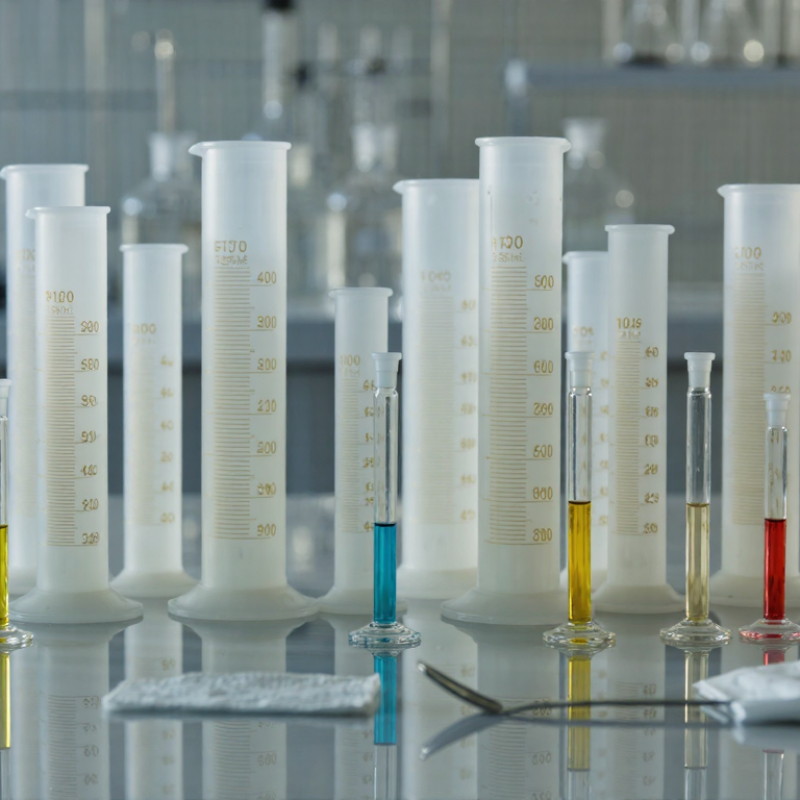
A PTFE measuring cylinder is a graduated laboratory vessel made from polytetrafluoroethylene. It measures liquid volume through marked graduations, much like glass or polypropylene cylinders. Its value comes from the material. PTFE resists many aggressive chemicals, absorbs very little moisture, and releases liquid easily from its smooth inner wall.
The cylinder does not improve measurement through chemistry. It improves handling in difficult environments. ASTM D4894 describes testing for PTFE resin, while ISO 6706 provides guidance for graduated measuring cylinders. Typical unfilled PTFE operates from about -200°C to 260°C, although exact limits depend on design and pressure. Its low friction, often reported near 0.05 to 0.10, helps reduce residue. Read the meniscus at eye level. Small errors still matter.
Tips: Check the graduation interval, wall thickness, and calibration temperature before purchase. Use a clean, stable surface. PTFE can deform under constant load, so avoid stacking heavy equipment on the rim. A 2023 fluoropolymer market analysis by Grand View Research reported continued demand from chemical processing and laboratory applications, but market growth does not guarantee measurement accuracy. That point deserves attention. A chemically resistant cylinder may still be unsuitable for precise volumetric work. Verify ISO 6706 conformity, temperature exposure, and compatibility with your actual liquids.
| Selection Dimension | Typical Data or Option | What It Means | Recommended Choice |
|---|---|---|---|
| Material | Polytetrafluoroethylene (PTFE) | A chemically resistant fluoropolymer with a low-friction, non-stick surface and very low water absorption. | Choose PTFE when chemical compatibility and contamination control are more important than low cost or high volumetric precision. |
| Common Capacity | 10, 25, 50, 100, 250, 500 and 1,000 mL | The nominal volume range covers small laboratory transfers through larger sample preparation tasks. | Select the smallest capacity that safely contains the required liquid volume for better reading control. |
| Graduation Interval | Approximately 0.2–20 mL, depending on cylinder capacity | Smaller cylinders generally have finer graduation spacing; larger cylinders usually use wider intervals. | Use a smaller graduation interval when an approximate volume reading is important. |
| Typical Graduation Examples | 10 mL: 0.2 mL; 25 mL: 0.5 mL; 50 mL: 1 mL; 100 mL: 1 mL; 250 mL: 2 mL; 500 mL: 5 mL; 1,000 mL: 10 mL | These are common nominal graduation patterns rather than a universal standard for every design. | Confirm the actual scale interval and calibration tolerance before using the cylinder for quantitative work. |
| Temperature Resistance | Approximately −200 to +260 °C for PTFE material service | PTFE remains functional across a broad temperature range, but the usable range depends on mechanical load, thermal cycling and the complete assembly. | Check the manufacturer’s stated service temperature for the specific cylinder before heating, cooling or autoclaving. |
| Chemical Resistance | Excellent resistance to most acids, bases, solvents and many corrosive reagents | PTFE is suitable for aggressive chemical handling, although certain molten alkali metals, elemental fluorine and high-temperature fluorinating agents can attack it. | Review a chemical compatibility chart for the exact reagent, concentration, temperature and exposure time. |
| Density | Approximately 2.14–2.20 g/cm³ | PTFE is significantly denser than water and many common laboratory plastics. | Use appropriate support and handling procedures for larger PTFE cylinders. |
| Water Absorption | Typically less than 0.01% by weight | Low moisture uptake helps maintain material stability and reduces water-related contamination. | Choose PTFE for applications requiring low moisture absorption or easy drying. |
| Surface Behavior | Low friction and non-stick surface | Many liquids drain readily, and residues are generally easier to remove than from rougher or more wettable materials. | Use PTFE when minimizing residue retention and simplifying cleaning is important. |
| Volume Reading Method | Read the liquid level at eye height; use the bottom of the meniscus for most aqueous liquids | Viewing angle and meniscus interpretation affect the apparent volume. | Use the same reading method consistently and avoid treating a graduated cylinder as a high-accuracy volumetric flask. |
| Accuracy Expectation | Approximate measurement; tolerance varies by design and capacity | Graduated cylinders are normally intended for measuring and transferring approximate volumes, not the highest-precision calibration. | For analytical accuracy, select a calibrated volumetric flask, pipette or balance-based method instead. |
| Transparency | Usually opaque or translucent rather than optically clear | Solid PTFE does not provide the same visual clarity as glass or transparent plastics, so the scale and liquid level may be less visible. | Choose a design with a clearly marked scale and adequate lighting for routine measurements. |
| Cleaning Method | Rinse promptly; use compatible laboratory detergent or solvent when required | The non-stick surface assists cleaning, but chemical residues can still remain around graduations, rims or molded features. | Verify cleaner compatibility and avoid abrasive tools that could damage the scale markings. |
| Best-Fit Applications | Corrosive-liquid transfer, sample preparation, trace-contamination-sensitive work and specialty laboratory processing | PTFE is selected mainly for chemical inertness, thermal range and low contamination risk. | Choose PTFE when these properties justify its higher material cost and lower visual transparency. |
| Key Limitations | Higher cost, opaque appearance, possible deformation under load at elevated temperature and limited suitability for certain fluorinating chemicals | Material resistance does not eliminate all mechanical, thermal or chemical limitations. | Evaluate temperature, load, reagent compatibility, visibility and required accuracy together before purchase. |
Technical note: Values shown are typical material or market-range data for selection purposes. Actual capacity, graduation interval, dimensional tolerance, temperature rating and chemical compatibility depend on the specific PTFE measuring-cylinder design and operating conditions.